
Quick Executive Summary: Heavy Duty Wooden Crates in Dubai & UAE
Transporting high-value industrial machinery, delicate aerospace components, oilfield equipment, and heavy electrical switchgear through Dubai’s global maritime and air freight corridors requires certified heavy duty wooden crates dubai engineered to international standards (ASTM D6039, BS 1133, and ISPM 15). Standard commercial cardboard or lightweight wooden boxes cannot withstand the extreme dynamic G-forces, ocean container resonance, high-humidity salt air, and rough crane handling encountered at Jebel Ali Port, Dubai World Central (DWC), and international breakbulk terminals. Al Rudhwan Carpentry designs and custom-fabricates heavy-duty timber-framed crates, fully enclosed marine plywood boxes, and heavy skid bases rated from 500 kg up to 25,000+ kg (25 metric tons), complete with internal shock-damping, anti-corrosion VCI barrier foil vacuum packaging, and certified IPPC heat treatment stamps.
Comprehensive Table of Contents
- 1. The Engineering Imperative: Why Heavy Industrial Crating Governs Dubai Logistics
- 2. Structural Typologies: Solid Plywood Enclosures vs. Heavy Timber Slat & Open Crates
- 3. High-Tonnage Skid Base Engineering: Center of Gravity & Forklift Pocket Analysis
- 4. Climatic & Maritime Defense: VCI Barrier Foils, Desiccants & Moisture Barriers
- 5. International Transport Standards: ASTM D6039, BS 1133 & ISPM 15 Compliance
- 6. Shock, Vibration & G-Force Damping Systems for Sensitive Equipment
- 7. Timber Fastener Mechanics: Ring-Shank Nails, Lag Bolts & Steel Corner Brackets
- 8. Heavy Crane Rigging & Lifting Dynamics: Spreader Bars & Sling Notch Safety
- 9. Air Cargo Volumetric Calculations & Aircraft Door Clearance Engineering
- 10. Jebel Ali Port & Breakbulk Export Clearance Protocols for Oversized Cargo
- 11. Dangerous Goods & Lithium Battery UN-Certified Wooden Packaging Standards
- 12. Security Seals, RFID Asset Tracking & Chain of Custody Integrity
- 13. 2026 Commercial Pricing Guide: AED Cost Breakdown by Crate Dimensions & Tonnage
- 14. On-Site Mobile Industrial Crating vs. Off-Site Factory Fabrication in Sharjah
- 15. Sector Case Studies: Oilfield Skids, Turbines, Aviation & Robotics Packaging
- 16. Technical Procurement Checklist: Specifying Lumber, Fasteners & Hardware
- 17. Frequently Asked Questions (FAQ) Regarding Heavy Duty Crating in Dubai
- 18. Conclusion & Requesting Your Engineering Crating Consultation
1. The Engineering Imperative: Why Heavy Industrial Crating Governs Dubai Logistics
Dubai stands as the primary re-export capital and heavy project cargo transshipment epicenter of the Middle East. Through DP World’s flagship Jebel Ali Port—the largest marine terminal in the Middle East—and Dubai World Central (Al Maktoum International Airport), billions of dirhams worth of high-value capital assets, industrial machinery, oil and gas drilling equipment, power generation turbines, and precision automated systems transit annually. However, shipping complex, heavy, and irregularly shaped equipment across international maritime and intermodal routes introduces severe structural, physical, and environmental hazards.
During an ocean voyage on container vessels, multi-purpose breakbulk carriers, or heavy-lift vessels, cargo is subjected to violent multi-directional dynamic forces. Ship motion generates six degrees of physical freedom: rolling, pitching, yawing, heaving, swaying, and surging. In rough maritime conditions, dynamic horizontal accelerations can exceed 1.0G, effectively doubling the apparent weight of the machinery against the interior crate walls. If the transport container or wooden crate is built with inadequate diagonal timber bracing, inferior lumber grades, or insufficient base skid thickness, the enclosure will rack, twist, or structurally implode under transit stress, leading to catastrophic internal machinery damage, fluid leakage, and total cargo loss.
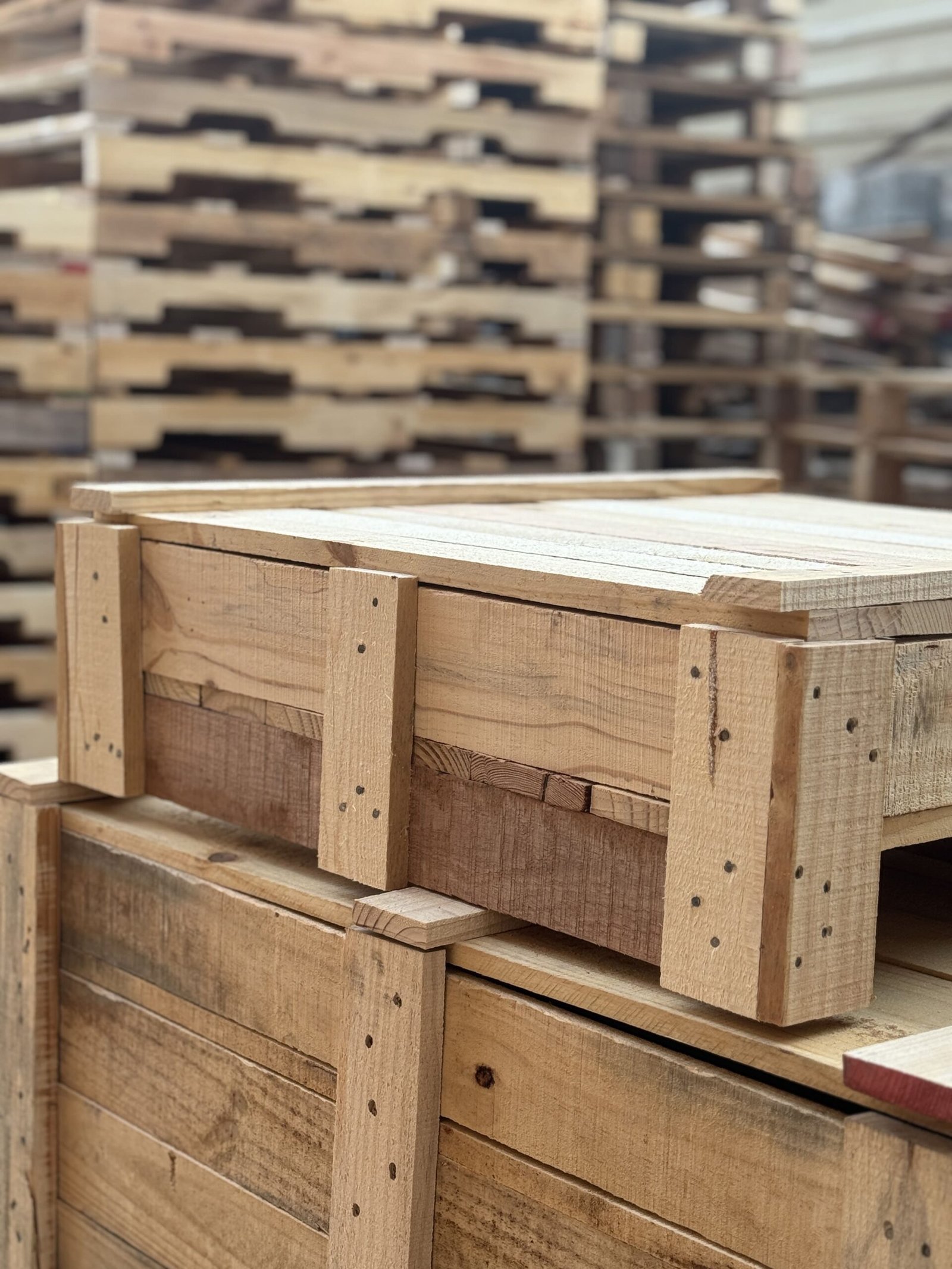
Furthermore, the physical transfer of cargo at port container terminals involves severe mechanical impacts. Container crane spreader drops, high-capacity rough-terrain forklift handling, side impacts from container lashing gear, and stack-compression loads from upper cargo tiers demand rigorous structural engineering. For UAE exporters, procuring professionally engineered heavy duty wooden crates dubai from Al Rudhwan Carpentry is not merely a packaging decision—it is an indispensable insurance policy protecting valuable capital investments against transit destruction, insurance claim disputes, and project delivery defaults.
In addition to physical dynamics, maritime routes transiting the Arabian Gulf, Indian Ocean, and Red Sea experience intense atmospheric salt spray and high relative humidity. Unprotected industrial steel oxidizes rapidly, and hygroscopic moisture accumulation within inferior wood causes fungal decay. Engineering high-integrity wooden crates requires holistic optimization of timber tensile strength, moisture barriers, and mechanical fastening to ensure the asset arrives at the international job site in the exact operating condition it departed the factory floor.
2. Structural Typologies: Solid Plywood Enclosures vs. Heavy Timber Slat & Open Crates
Selecting the appropriate crate architecture depends upon the specific vulnerability of the cargo, weight distribution, destination climatic conditions, and transport mode (air freight vs. ocean breakbulk vs. flat-rack container). Industrial wooden packaging is categorized into three primary structural typologies:
A. Fully Enclosed Marine Plywood Crates
Constructed using exterior-grade WBP (Water and Boil Proof) marine plywood panels sheathed over a solid timber dimensional frame. Delivers total 360-degree environmental sealing, prevents theft/pilferage, shields against solar UV degradation, and allows for hermetic vacuum barrier bag sealing. Mandatory for electronic instrumentation, aerospace avionics, and sensitive machinery.
B. Heavy Open-Slat / Skeleton Crates
Fabricated with solid softwood or hardwood framing boards spaced with uniform structural gaps (typically 50mm to 100mm between slats). Reduces total tare weight by 30% to 40% (generating substantial air freight savings) while providing rigid impact protection. Ideal for robust cast-iron valves, structural steelwork, pipe spools, and non-sensitive metal fabrications.
C. Heavy Industrial Machine Skids & Hoods
Features an ultra-heavy solid timber skid platform (utilizing 100x100mm to 200x200mm beams) bolted to the machinery base, paired with a demountable lift-off wooden hood. This modular design allows complex machinery to be anchored, tested, and inspected prior to securing the protective exterior shell. Engineered for extreme payloads exceeding 20 metric tons.
| Structural Feature | Solid Plywood Enclosed Crate | Open-Slat Timber Crate | Heavy Skid & Demountable Hood |
|---|---|---|---|
| Environmental Protection | Maximum (100% Hermetic / VCI) | Moderate (Physical Only) | High (When Paired with Foil Wrap) |
| Tare Weight Profile | Medium to Heavy | Lightest (Optimal for Air Cargo) | Heavy to Extreme Heavy Duty |
| Maximum Payload Rating | Up to 8,000 kg | Up to 5,000 kg | Up to 25,000+ kg (25 Metric Tons) |
| Customs Inspection Friendly | Requires Screwed Inspection Hatch | Instant Visual Clearance | Hood Lift-Off or Port Access Panels |
| Recommended Cargo Types | Switchgear, CNCs, Robotics, Avionics | Pipes, Steel Castings, Pump Housings | Turbines, Generators, Compressors |
3. High-Tonnage Skid Base Engineering: Center of Gravity & Forklift Pocket Analysis
The structural foundation of any heavy-duty industrial wooden crate is its skid base. Over 70% of structural crate failures occur not at the sidewalls or roof, but through the catastrophic flexing, splitting, or rolling of undersized base runners during lifting operations. At Al Rudhwan Carpentry, our structural engineers model every heavy base skid in strict accordance with mechanical load-deflection formulas and ASTM D6039 criteria.
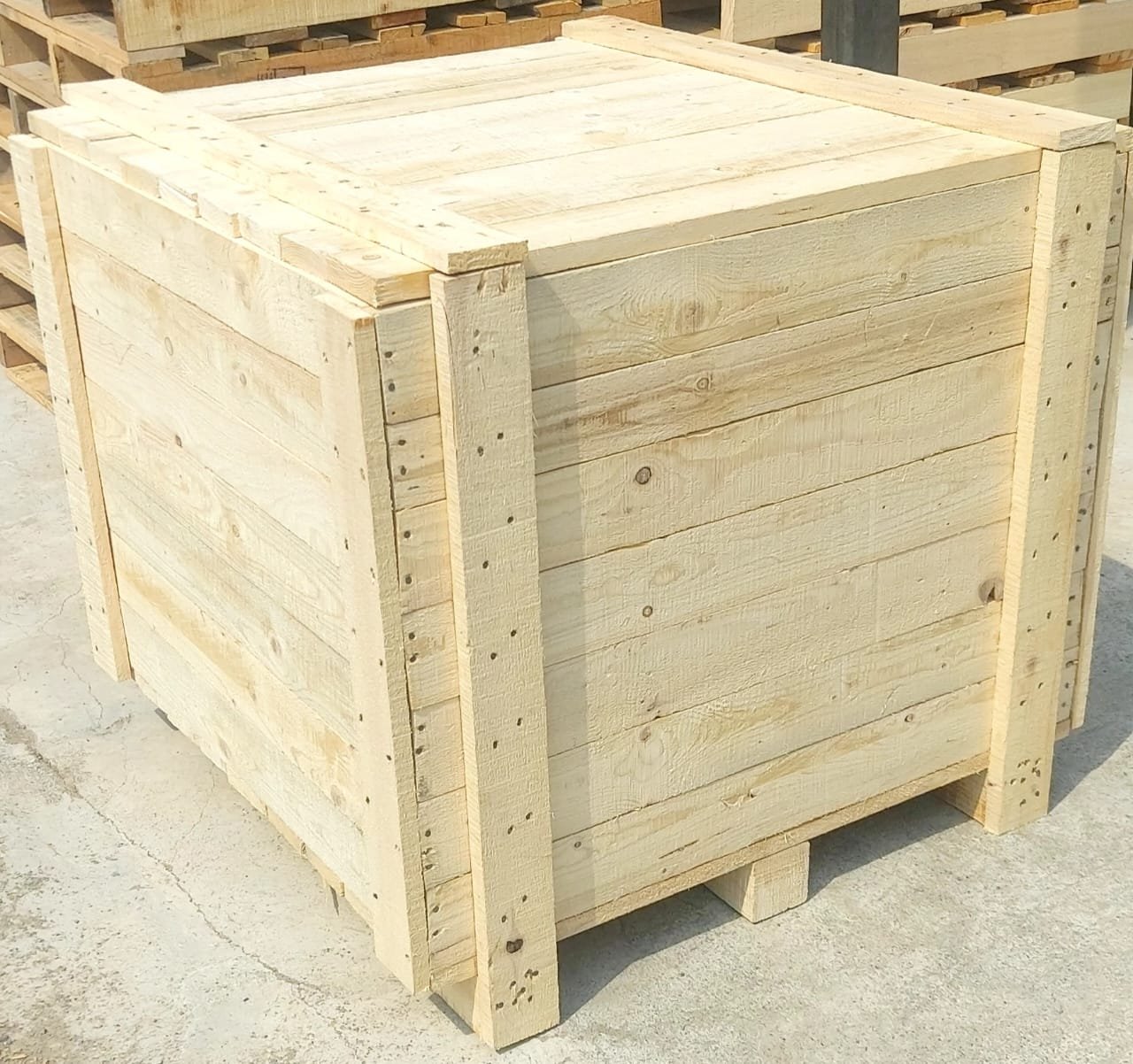
Key engineering elements incorporated into Al Rudhwan Carpentry’s heavy-duty skid platforms include:
- Longitudinal Timber Runners (Skids): Fabricated from dense European whitewood, red pine, or tropical hardwood beams sized from 100x100mm up to 200x200mm cross-sections depending upon cargo mass and overall span. Runners are chamfered at both ends to facilitate dragging, skidding, and smooth conveyor transit.
- Heavy Transverse Headers & Rubbing Strips: Bolted perpendicular across the runners to distribute concentrated equipment foot-loads across the entire platform footprint, preventing localized punch-through failures.
- Precision Forklift Pocket Engineering: Strategically positioned four-way or two-way forklift pockets reinforced with steel plates to prevent tine damage during multi-stage handling across logistics yards.
- Center-of-Gravity (CoG) & Lifting Sling Notches: For asymmetrical machinery (such as diesel engine generator sets or eccentric drive compressors where the motor represents 80% of total mass), our engineering team calculates the exact mathematical Center of Gravity. The external crate exterior is clearly stenciled with universal ISO lifting symbols and fitted with heavy steel sling notches, ensuring crane operators rig the cargo safely without balance loss.
- Internal Mechanical Anchor Points: High-tensile steel tie-down D-rings, through-bolt fixtures, and custom contoured timber chocks that physically lock the machine base to the skid floor, preventing horizontal shift during vessel roll or truck emergency braking.
Calculating the bending moment and maximum allowable deflection of timber runners requires precise structural engineering formulas. Under peak dynamic loading, maximum beam deflection must not exceed L/360 of the unsupported span between forklift tines or crane sling locations. When transporting sensitive rotor shafts, turbine impellers, or calibrated granite measurement tables, even 2 millimeters of base flexing can distort internal tolerances. Our engineers incorporate intermediate steel I-beams or structural laminated veneer lumber (LVL) flitch plates inside timber skids for spans exceeding 4 meters, guaranteeing absolute geometric rigidity.
4. Climatic & Maritime Defense: VCI Barrier Foils, Desiccants & Moisture Barriers
One of the most dangerous threats to industrial machinery originating from or transiting through Dubai is climatic moisture degradation. The United Arab Emirates experiences extreme coastal humidity during summer and autumn months, with ambient temperatures surpassing 45°C. When a sealed wooden crate is loaded aboard a container vessel sailing from Jebel Ali Port through the Indian Ocean, the Red Sea, or across equatorial transit zones, severe day-to-night temperature swings induce rapid condensation on bare metal surfaces—a destructive phenomenon known across maritime logistics as “cargo sweat.”
Without professional climatic packaging, unpainted polished steel shafts, CNC spindle bearings, electrical circuit boards, hydraulic manifolds, and machined flanges will develop aggressive surface rust, galvanic pitting, and electrical short-circuits within 10 to 14 days of ocean transit. Al Rudhwan Carpentry integrates advanced multi-layer military-spec environmental defense systems directly within our custom crates:
- Mil-Spec Aluminum Barrier Foil Vacuum Packaging (MIL-PRF-131K Class 1): The machinery is completely encapsulated inside an impermeable heavy-gauge aluminum laminate barrier foil bag. Industrial vacuum extraction systems remove trapped ambient air, and the perimeter seams are hermetically heat-sealed utilizing pneumatic thermal sealing jaws at temperatures exceeding 200°C. Water vapor transmission rate (WVTR) is virtually zero (< 0.005 g/m²/24hr), preventing atmospheric moisture infiltration.
- Volatile Corrosion Inhibitor (VCI) Emitters: Inside the barrier envelope, specialized VCI poly-film and VCI emitting diffusers release micro-molecular corrosion-inhibiting vapors. These vapors volatilize throughout the enclosure, creating an invisible, monomolecular protective layer across all ferrous and non-ferrous metal surfaces that arrests oxidation without requiring greasy preservative oils.
- Calibrated Activated Clay & Silica Desiccants (DIN 55474 / MIL-D-3464E): Desiccant quantities are mathematically calculated based on total internal crate volume, barrier foil surface area, and planned transit duration (e.g., 30, 60, or 120 days). Calibrated desiccant packs absorb all residual internal moisture, maintaining relative humidity inside the barrier bag below 30% throughout the entire international voyage.
- Relative Humidity Indicator Windows: Sealed inspection windows with multi-spot colorimetric humidity indicator cards allow customs officers and cargo receivers to verify internal climatic dryness without breaching the hermetic vacuum barrier seal.
5. International Transport Standards: ASTM D6039, BS 1133 & ISPM 15 Compliance
Global engineering procurement standards mandate that industrial packaging conform to validated technical codes. Delivering multi-million dirham machinery in non-compliant packaging exposes contractors to severe project warranty disputes. Al Rudhwan Carpentry fabricates all heavy duty wooden crates dubai in strict adherence to international packaging and phytosanitary engineering standards:
- ASTM D6039 / D6039M: Standard Specification for Open and Covered Wood Crates. Governs dimensional timber sizing, diagonal brace configurations, nail patterns, plywood thickness, and base skid deflection criteria for light, medium, and heavy-duty industrial classes.
- BS 1133 (Packaging Code Section 8 & Section 10): British Standard governing timber packaging boxes, crates, and metal-fastened cases for industrial, export, and military transport logistics.
- DIN 1052 & EN 1995-1-1 (Eurocode 5): Structural design and engineering of timber connections, fastener withdrawal resistances, and beam deflection calculations under dynamic payload stresses.
- ISPM 15 Heat Treatment Certification: All solid timber utilized in framing, base skids, blocking, and bracing undergoes certified thermal kiln processing at 56°C for a minimum of 30 minutes at our Sharjah kiln facilities. Each completed crate is branded with our registered IPPC compliance mark (AEHT-0069) and accompanied by official certification, guaranteeing 100% customs clearance at all global ports.
6. Shock, Vibration & G-Force Damping Systems for Sensitive Equipment
Precision equipment—such as medical diagnostic scanners, semiconductor inspection instruments, laboratory cleanroom modules, and aerospace navigational avionics—cannot tolerate high shock impulses. During transit, truck chassis vibrations, railway coupling jolts, and crane hoist sudden drops generate G-forces ranging from 5G to over 30G, which can easily shatter calibrated optics, misalign drive shafts, or fracture internal ceramic substrates.
Al Rudhwan Carpentry engineers custom multi-stage shock attenuation systems tailored to the exact fragility rating (maximum permissible G-force) of your asset:
- Elastomeric & Neoprene Shock Mounts: Heavy-duty industrial rubber-in-shear mounts positioned between the floating machine base platform and the external crate skid runners, damping vertical and horizontal shock waves.
- Cross-Linked Closed-Cell Polyethylene (Ethafoam): Precision CNC-routed foam blocking and corner pads that cradle the machinery, distributing shock energy across wide surface areas while resisting petroleum solvents and moisture absorption.
- External Visual Impact & Tilt Indicators: Tamper-evident ShockWatch impact indicators (calibrated from 10G to 75G) and TiltWatch sensors installed on crate exteriors. These sensors permanently trip if the crate is dropped, impacted, or tipped beyond 80 degrees, establishing clear carrier liability in the event of rough handling.
7. Timber Fastener Mechanics: Ring-Shank Nails, Lag Bolts & Steel Corner Brackets
A wooden crate’s structural integrity is only as strong as its joint connections. Many low-cost packaging providers in the UAE utilize standard smooth-shank wire nails driven straight into lumber. Under continuous road vibration across Dubai highways and the cyclical pitching of container vessels, smooth nails rapidly loosen due to mechanical withdrawal stress—a condition known as “nail creep.” Once fasteners back out, panels separate and the entire box shears apart under dynamic load.
Al Rudhwan Carpentry executes precision fastener engineering across every joint assembly:
Fastener Engineering Specifications:
- Ring-Shank & Screw-Shank Galvanized Nails: Helical rolled threads bite deeply into timber wood fibers, increasing withdrawal resistance by over 300% compared to smooth nails. Fasteners are driven at opposing 45-degree angles to create mechanical timber dovetail locking.
- High-Tensile Grade 8.8 Through-Bolts: Skid runners and heavy upright structural posts are joined utilizing M12 to M20 through-bolts fitted with heavy-gauge oversized square steel washers to prevent bolt-head crushing under multi-ton tightening torques.
- Heavy Cold-Rolled Steel Corner Brackets: For crates exceeding 3,000 kg gross weight, exterior corners are reinforced with 3mm galvanized structural steel angle brackets through-bolted to horizontal and vertical timbers. This prevents racking distortion when crates are lifted by rigging slings.
- Demountable Panel Latches & Cam-Locks: Where crates must be repeatedly opened and closed for field maintenance, equipment testing, or customs border inspections, we install recessed steel spring latches or industrial Klimp fasteners, eliminating the need to pry open wooden panels and damage structural lumber.
8. Heavy Crane Rigging & Lifting Dynamics: Spreader Bars & Sling Notch Safety
Handling multi-ton industrial wooden packaging at port quaysides requires strict adherence to heavy-lift mechanical principles. When dockside cranes hoist a heavy crate using wire rope or synthetic web slings wrapped around the base, the slings exert extreme inward compressive lateral forces across the top roof structure of the crate. If the crate roof was built without heavy internal spreader headers, these crushing forces will instantly cave in the roof panels, crushing the equipment enclosed inside.
Al Rudhwan Carpentry prevents lifting crush failures through integrated crane rigging engineering:
- Internal Heavy Compression Spreaders: High-density timber joists (sized up to 100x150mm) positioned directly in line with external sling lift zones, transferring inward sling pressure safely through the wood structure without transferring load to delicate machinery components.
- Sling Notch Steel Edge Protectors: Base runners feature CNC-routed sling notches reinforced with heavy steel chafe plates. These notches prevent rigging slings from sliding toward the center of gravity during hoist acceleration, eliminating sudden crate tipping hazards.
- Mandatory Spreader Bar Stenciling: For crates exceeding 4 meters in length or having a high center of gravity, crate exteriors are stenciled in high-visibility reflective enamel with instructions: “LIFT ONLY WITH SPREADER BAR AT INDICATED SLING POINTS” to prevent crane operators from using steep angular sling hitches.
- Certified Pad Eyes & Swivel Hoist Rings: Where specified for offshore oilfield skids, our workshop integrates certified steel lifting pad eyes through-bolted to the primary timber runners, load-tested and certified to meet LEEA (Lifting Equipment Engineers Association) safety criteria.
9. Air Cargo Volumetric Calculations & Aircraft Door Clearance Engineering
Exporting high-priority industrial components via air freight through Emirates SkyCargo at Dubai International (DXB) or flydubai Cargo at DWC requires balancing physical impact protection against chargeable volumetric weight. Under IATA air cargo formulas, chargeable weight is calculated based on the dimensional divisor formula: Length (cm) x Width (cm) x Height (cm) / 6,000. An excessively bulky crate can double your air freight costs.
Al Rudhwan Carpentry optimizes air cargo crates through strict dimensional engineering:
- Aircraft Main Deck vs Lower Deck Door Clearances: We model crate envelopes against standard freighter aircraft cargo doors—including the Boeing 777F main cargo door (305 x 372 cm) and lower deck door (168 x 178 cm)—ensuring packages fit onto standard PMC or PAG aircraft pallets without costly offloading.
- High-Strength Engineered Plywood Sheathing: Utilizing thin, ultra-dense 9mm or 12mm birch plywood sheathing on softwood skeleton frames delivers extreme puncture resistance while reducing tare weight by hundreds of kilograms compared to solid timber boxes.
- Integrated Aircraft Lashing Tie-Down Channels: Heavy aircraft crates are built with recessed tie-down slots that align with aircraft cargo net anchor tracks, preventing shifting during air turbulence and runway takeoff acceleration.
10. Jebel Ali Port & Breakbulk Export Clearance Protocols for Oversized Cargo
Managing oversized or Out-of-Gauge (OOG) cargo through DP World’s Jebel Ali Port requires strict adherence to port safety and container terminal stowage guidelines. For machinery exceeding standard ISO container dimensions (exceeding 2.35m width or 2.39m height), equipment must be mounted onto 20ft/40ft Flat Rack containers, Open Top containers, or chartered directly as breakbulk cargo in the ship’s hold.
Our industrial packaging engineering division coordinates directly with maritime freight forwarders and marine cargo surveyors to ensure full terminal compliance:
- Flat-Rack Lashing & Dunnage Calculations: We engineer heavy-duty timber dunnage bases and chocks aligned with the corner casting and lashing ring coordinates of flat-rack containers, ensuring certified chain and strap lashings achieve the required safety load factors under IMO/ILO/UNECE CTU Code standards.
- DP World Breakbulk Lifting Inspections: For heavy crated packages exceeding 10 metric tons, port safety inspectors require verified tare weight markings, certified Center-of-Gravity center lines, and designated crane hook lifting lug cutouts to ensure safe dockside crane rigging.
- Customs Mirsal II Digital Pre-Filing: Our administrative compliance team provides verified packing lists, technical crate dimension schematics, and official MOCCAE heat treatment certificates to expedite rapid customs gate clearance, avoiding costly port demurrage and container detention fees.
11. Dangerous Goods & Lithium Battery UN-Certified Wooden Packaging Standards
With Dubai positioning itself as a central hub for renewable energy, electric vehicle components, and chemical trading, transporting Dangerous Goods (DG) under IATA (air freight) and IMDG (maritime ocean freight) regulations requires specialized wooden packaging certified to United Nations (UN) performance standards.
Packaging Class 9 dangerous goods—specifically large industrial Lithium-Ion battery energy storage systems (BESS), solar inverters, chemical reactors, and radioactive laboratory sources—demands rigorous packaging compliance:
- UN 4D (Plywood Box) & UN 4C1/4C2 (Solid Wood Box) Certification: Packaging must undergo third-party drop testing, stacking tests, and puncture resistance verification to earn official UN certification markings (e.g., UN 4D/Y50/S/26/AE/…).
- Thermal Runaway & Fire Retardant Liners: For lithium battery transport, internal crate cavities are lined with intumescent fire-retardant barriers, non-combustible vermiculite insulation, or ceramic fiber blankets engineered to contain high thermal runaway temperatures exceeding 1,000°C without breaching the external timber enclosure.
- Gasketed Hermetic Closures: Crates handling volatile or off-gassing materials feature neoprene perimeter lid gaskets and one-way pressure-equalizing breather valves to prevent atmospheric pressure differential rupture during high-altitude air cargo transit.
12. Security Seals, RFID Asset Tracking & Chain of Custody Integrity
High-value industrial consignments—such as precision tooling, turbine spare parts, and copper wire coils—are frequent targets for cargo pilferage at international transshipment ports. Al Rudhwan Carpentry incorporates comprehensive anti-tamper security features directly into our heavy crates:
- Perimeter Steel Strapping & Tamper-Evident Seals: High-tensile 32mm blued steel strapping secured with crimped seals across all panel joints. Removing a panel requires cutting the steel bands, providing immediate visual evidence of tampering.
- Serial Numbered Security Cable Seals: Inspection doors and maintenance hatches are secured with ISO 17712 high-security barrier cable seals matching shipping manifest documentation.
- Integrated GPS & RFID Sensor Cavities: For multi-million dirham project cargo, we route recessed internal cavities within timber skids to house real-time satellite GPS tracking devices and shock-logging sensors, enabling shippers to monitor location, temperature, and G-force impacts in real time via cloud dashboards.
13. 2026 Commercial Pricing Guide: AED Cost Breakdown by Crate Dimensions & Tonnage
Commercial pricing for industrial wooden packaging is determined by volumetric displacement (cubic meters), timber species grade (European pine vs. hardwood), plywood thickness (9mm, 12mm, 18mm), base skid tonnage engineering, and internal barrier foil/foam specifications.
Below is Al Rudhwan Carpentry’s comprehensive 2026 commercial pricing matrix for custom-engineered heavy duty wooden crates dubai fabricated at our Sharjah manufacturing facility:
| Crate Class / Category | Typical External Dimensions (mm) | Payload Capacity | Standard Unit Price (AED) | With Mil-Spec VCI Foil & Desiccant |
|---|---|---|---|---|
| Light Industrial Equipment Crate | 1200 x 800 x 800 mm | Up to 750 kg | AED 220 – 310 | AED 340 – 430 |
| Medium Industrial Machinery Crate | 1800 x 1200 x 1200 mm | Up to 2,500 kg | AED 480 – 650 | AED 680 – 850 |
| Heavy Machine Tool / CNC Enclosure | 2500 x 1600 x 1800 mm | Up to 6,000 kg | AED 890 – 1,250 | AED 1,200 – 1,600 |
| Heavy Oilfield Valve / Pump Skid | 3000 x 2000 x 2000 mm | Up to 12,000 kg | AED 1,650 – 2,400 | AED 2,200 – 3,100 |
| Oversized Project Cargo / Turbine Skid | 4500 x 2800 x 2800 mm+ | Up to 25,000+ kg | AED 3,800 – 7,500+ | Custom Engineering Contract |
*Note: Stated prices are in UAE Dirhams (AED) exclusive of standard 5% VAT. Bulk volume orders (10+ units) receive tiered enterprise discounts up to 25%. Free direct factory delivery to industrial zones across Dubai, Sharjah, and JAFZA is included on orders exceeding AED 3,000.
14. On-Site Mobile Industrial Crating vs. Off-Site Factory Fabrication in Sharjah
Industrial clients frequently encounter machinery that cannot be easily transported to an off-site packaging workshop due to extreme weight, sensitive optical alignment, or strict security protocols inside free zones. Al Rudhwan Carpentry resolves this challenge by providing dual operational packaging models:
Model A: Off-Site Factory Fabrication & Rapid Delivery
Crates are custom-engineered and precision-prefabricated at our Sharjah Industrial Area 13 production plant. Crates can be delivered fully assembled or supplied in flat-pack knocked-down (KD) panel format with pre-drilled bolt holes and quick-clamp latches, enabling your warehouse team to pack and seal the cargo in under 15 minutes.
Model B: Mobile On-Site Packing Teams (Across UAE)
Our mobile packaging team arrives directly at your factory, warehouse, or job site in Dubai, JAFZA, Abu Dhabi, or Sharjah equipped with mobile power generators, pneumatic nailers, certified heat-treated timber, VCI barrier vacuum welders, and heavy rigging jacks. We construct the heavy skid base beneath the machine, secure anchor bolts, vacuum-seal barrier foils, and build the crate enclosure around the asset on-site.
15. Sector Case Studies: Oilfield Skids, Turbines, Aviation & Robotics Packaging
Every major industrial sector in the United Arab Emirates possesses specialized mechanical packaging requirements. Our structural engineering department delivers proven crating solutions across key vertical markets:
A. Oilfield Drilling & Upstream Subsea Equipment
Oil and gas exploration firms operating in Abu Dhabi, Sharjah, and JAFZA routinely export heavy subsea Christmas trees, high-pressure blow-out preventers (BOPs), drill bits, and pump manifolds. We construct solid hardwood skid bases using 150x150mm treated beams secured with high-tensile steel tie-down rods, rated for offshore platform crane handling and multi-ton dynamic ocean pitching.
B. Power Generation & Heavy Electrical Switchgear
High-voltage electrical switchgear, step-down transformers, and motor control centers (MCCs) are highly vulnerable to internal moisture condensation and structural racking. Al Rudhwan Carpentry fabricates heavy-gauge plywood enclosures featuring internal desiccant vacuum barrier bags, rubber vibration isolator mounts, and water-shedding pitched roof caps that prevent pooling water during outdoor storage.
C. Aerospace & Commercial Aviation Spares
Aviation MRO facilities at Dubai South and Sharjah International Airport require specialized packaging for aircraft engines, composite nacelles, landing gear assemblies, and avionics flight computers. We engineer ATA-300 compliant reusable wooden flight crates fitted with custom CNC Ethafoam saddles, recessed butterfly twist latches, heavy spring-loaded handles, and integrated shock indicators.
D. Industrial Robotics & High-Speed Automated Machinery
Automated manufacturing facilities in Dubai Industrial City and KIZAD exporting articulated robotic arms, Cartesian pick-and-place robots, and laser cutting heads demand zero rotational or axial deflection during transport. We engineer dual-layer isolation crates where the primary robotic chassis is isolated on pneumatic dampers, shielded within an internal floating wooden sub-frame suspended inside the heavy exterior crating envelope.
16. Technical Procurement Checklist: Specifying Lumber, Fasteners & Hardware
When issuing a Request for Quotation (RFQ) for heavy-duty industrial crates, supply chain officers should specify clear structural parameters to ensure vendor quotes reflect genuine heavy-duty performance:
- Gross Payload & Weight Distribution: Total machine mass, identifying whether weight is symmetrically balanced or concentrated on specific base feet.
- Overall Net & Gross Dimensions: Exact length, width, and height (including all protruding handles, gauges, pipe flanges, and terminal boxes).
- Skid Runner Dimensions: Specify minimum runner cross-section (e.g., 4×4 inch or 6×6 inch) and timber species (softwood vs. structural hardwood).
- Wall Sheathing Material: Specify panel type (12mm or 18mm exterior WBP marine plywood vs. 20mm solid pine tongue-and-groove boards).
- Fastening Hardware: Require ring-shank galvanized nails, perimeter corner steel angle irons, and through-bolts rather than standard wire brads.
- Environmental Barrier Requirements: Mandate MIL-PRF-131K aluminum barrier foil, calculated desiccant units, and VCI emitting diffusers for all maritime sea freight shipments.
- Phytosanitary Mandate: Confirm all solid timber components carry registered IPPC ISPM 15 heat treatment stamps and official treatment certificates.
17. Frequently Asked Questions (FAQ) Regarding Heavy Duty Crating in Dubai
Q1: What is the maximum payload weight Al Rudhwan Carpentry can engineer a wooden crate for?
We engineer and fabricate custom heavy-duty crates and skid platforms rated for payloads ranging from 250 kg up to 25,000+ kg (25 metric tons). For extreme heavy machinery, we utilize multi-beam solid hardwood skids, reinforced steel corner gussets, and high-tensile steel through-bolt anchor rods.
Q2: Are all heavy-duty wooden crates certified under ISPM 15 standards?
Yes. All solid structural lumber utilized in our frames, skids, and bracing undergoes certified heat treatment (HT 56°C for 30 minutes) in our Sharjah kiln facilities. Each crate is branded with our official IPPC mark (AEHT-0069) and accompanied by an official compliance certificate required for customs clearance worldwide.
Q3: Can your team pack and build the wooden crate at our factory in Dubai or JAFZA?
Yes. We deploy fully equipped mobile industrial packing teams across Dubai, JAFZA, Sharjah, Abu Dhabi, and KIZAD. Our mobile technicians handle on-site skid construction, machinery bolting, barrier foil vacuum packing, desiccant placement, and final exterior crate assembly directly at your facility.
Q4: How does vacuum barrier foil packaging protect machinery during ocean shipping?
Mil-Spec aluminum barrier foil completely isolates the machinery from external air, ocean humidity, and salt fog. By extracting the air and inserting calculated desiccant charges, relative humidity inside the envelope is maintained below 30%, preventing corrosion, rust, and mold growth for up to 12 months.
Q5: What is the typical turnaround time for custom heavy-duty crates in the UAE?
Standard custom crates are typically fabricated and delivered within 24 to 48 hours of dimensional sign-off. For emergency vessel cutoff dates or AOG (Aircraft on Ground) shipments, we offer 24-hour expedited fabrication and mobile on-site deployment.
Q6: What is the difference between an open-slat crate and a solid plywood box?
An open-slat crate features spaced timber boards, offering structural impact protection with reduced tare weight (ideal for air cargo and robust metal parts). A solid plywood box provides complete 360-degree environmental sealing, security against pilferage, and total weather protection for sensitive machinery and electronics.
Q7: Do you provide lashing and securing services for flat-rack and open-top containers?
Yes. In addition to crate fabrication, our rigging team provides complete sea container lashing, heavy timber blocking and chocking, and certified steel chain tie-downs on Flat Racks and Open Tops in full compliance with DP World and IMO CTU guidelines.
Q8: How do I request a formal engineering quotation for custom crating?
Simply send your cargo dimensions (L x W x H), estimated gross weight, machinery photos, and transport mode via WhatsApp to +971 50 898 6636 or call our factory directly. Our technical sales engineers will provide an exact 2D dimensional drawing and commercial quote within 2 business hours.
Q9: Can custom crates be engineered for multi-trip reusable deployment?
Yes. We engineer reusable industrial flight cases and modular trade show/exhibition crates equipped with steel piano hinges, quick-release cam-lock latches, heavy corner ball protectors, and durable polyurethane finishes rated for 20+ round-trip logistics cycles.
Q10: Are Al Rudhwan Carpentry crates approved for export to Saudi Arabia and the GCC?
Yes. Our packaging carries authentic IPPC stamps and certified paperwork fully compliant with Saudi ZATCA customs requirements and GCC Unified Customs regulations, ensuring prompt border transit through Batha and Ghuwaifat.
18. Conclusion & Requesting Your Engineering Crating Consultation
When shipping high-value industrial machinery, precision aerospace parts, or heavy oilfield equipment across international borders, packaging failure is not an option. Al Rudhwan Carpentry delivers verified structural integrity, ISPM 15 compliance, advanced climatic defense, and responsive on-site packaging services across Dubai, Sharjah, Abu Dhabi, and the entire United Arab Emirates. Our team of certified timber engineers, master joiners, and mobile packaging technicians ensures that every heavy-duty crate leaving our facility is mathematically modeled, structurally reinforced, and fully compliant with global shipping regulations.
By leveraging factory-direct mill pricing, localized warehouse delivery fleets, and 24/7 emergency crating response capabilities, we empower UAE industrial exporters to eliminate port customs friction, avoid costly maritime cargo damage claims, and maintain seamless international project execution timelines.
Protect Your Heavy Cargo Consignments: Get a Factory Direct Crate Quote
Speak directly with our industrial packaging engineers. From individual custom crates to comprehensive turnkey on-site plant packing, we deliver uncompromising structural protection at direct manufacturer rates.