
Quick Executive Summary: Sourcing ISPM 15 Certified Wooden Pallets in UAE
For commercial enterprises and export manufacturers operating across Dubai, JAFZA, Sharjah, and Abu Dhabi, utilizing fully certified ispm 15 certified wooden pallets uae is a mandatory statutory requirement under the International Plant Protection Convention (IPPC). Non-compliant, untreated timber shipments face immediate detention, mandatory port fumigation fines (AED 1,500 to AED 4,500 per container), or complete customs rejection at DP World Jebel Ali, Port Khalifa, and foreign import terminals across North America, Europe, Australia, and the GCC. Al Rudhwan Carpentry operates licensed heat treatment kilns operating at core wood temperatures exceeding 56°C for a minimum continuous duration of 30 minutes, producing stamped, audited, and customs-ready Euro, ISO, chemical CP, and custom industrial pallets backed by official phytosanitary compliance documentation.
Comprehensive Table of Contents
- 1. The Regulatory Imperative: Why ISPM 15 Certification Governs UAE Industrial Logistics
- 2. Heat Treatment (HT) Engineering: Core Temperature Chamber Mechanics & Thermal Profiling
- 3. Anatomy of the Official IPPC Stamp: Decoding Registration Symbols & Verifications
- 4. Standard Industrial Pallet Dimensions & Specifications Matrix (Euro, ISO, CP1-CP9)
- 5. Structural Load Capacities: Dynamic vs. Static vs. High-Bay Racking Engineering
- 6. Timber Material Science: Hardwood vs. Softwood vs. Kiln Dried Moisture Control
- 7. Comparative Global Customs Border Protocols: EU, USDA APHIS, Australia DAFF & GCC ZATCA
- 8. UAE Customs & Maritime Clearance Protocols: JAFZA, DP World & Port Khalifa
- 9. 2026 Commercial Pricing Guide: AED Cost Breakdown & Bulk Volume Discount Tiers
- 10. New vs. Reconditioned Heat-Treated Pallets: Life Cycle Economics & Environmental Audits
- 11. Critical IPPC Stamping Deficiencies & Avoiding Port Rejections
- 12. Step-by-Step B2B Procurement Workflow: Custom Specifications, Load Testing & Dispatch
- 13. Sector Applications: Petrochemical, Heavy Machinery, FMCG & Cold Chain Solutions
- 14. Technical Frequently Asked Questions (FAQ) Regarding ISPM 15 in the UAE
- 15. Conclusion, Quality Checklists & Placing Your Factory Direct Order
1. The Regulatory Imperative: Why ISPM 15 Certification Governs UAE Industrial Logistics
The International Standards for Phytosanitary Measures No. 15 (ISPM 15) represents the global standard developed by the International Plant Protection Convention (IPPC), an operational body of the United Nations Food and Agriculture Organization (FAO). Its primary regulatory purpose is to prevent the international introduction, transboundary movement, and ecological proliferation of destructive quarantine pests and xylophagous organisms—including the Asian Longhorned Beetle (Anoplophora glabripennis), the Pine Wood Nematode (Bursaphelenchus xylophilus), and various species of subterranean termites and wood-boring bark beetles—through solid wood packaging material (WPM) utilized in cross-border ocean, air, and overland commercial freight.
In the United Arab Emirates, where Dubai and Abu Dhabi serve as central logistics gateways connecting the Far East, Europe, Africa, and North America, regulatory scrutiny over international cargo transit is exceptionally rigorous. The UAE Ministry of Climate Change and Environment (MOCCAE), functioning in direct coordination with Dubai Customs, DP World at Jebel Ali Port, Abu Dhabi Ports (AD Ports Group at Port Khalifa), and Sharjah Ports Authority, enforces strict statutory oversight over all incoming and outbound timber transport packaging. Every consignment of solid timber dunnage, industrial skids, wooden packaging crates, and ispm 15 certified wooden pallets uae fabricated from raw coniferous or non-coniferous timber with a thickness exceeding 6 millimeters must carry indelible, standardized verification markings attesting to approved phytosanitary processing.
For industrial manufacturers, oil and gas suppliers, chemical producers, and freight forwarding agencies operating across the UAE, compliance failure carries immense commercial and logistical penalties. When an uncertified, improperly heat-treated, or fraudulently marked wooden pallet consignment arrives at customs inspection checkpoints in Europe, the United States, Japan, China, or GCC member states like Saudi Arabia (under Zakat, Tax and Customs Authority – ZATCA regulations), border control officers have absolute statutory jurisdiction to execute immediate enforcement actions. These interventions include mandatory dockside quarantine, compulsory quarantine fumigation at rates frequently exceeding AED 2,500 to AED 4,500 per shipping container, total rejection of entry, or the immediate, non-negotiable re-exportation of the cargo back to the UAE port of origin at the shipper’s sole financial expense.
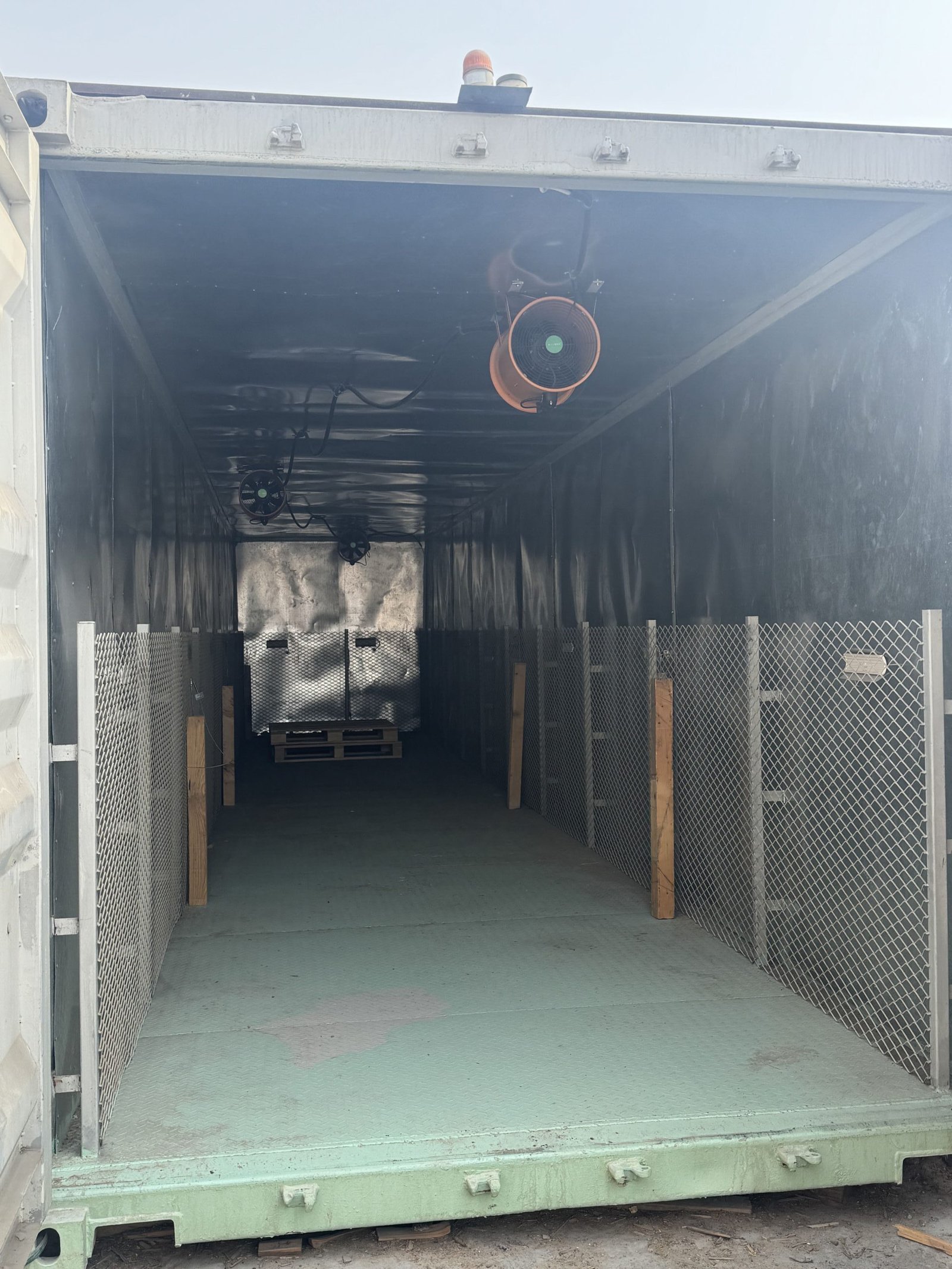
Understanding these critical operational dynamics highlights why selecting an accredited, fully certified industrial manufacturer like Al Rudhwan Carpentry is an essential operational safeguard. Rather than relying on unverified third-party brokers or questionable secondhand timber traders who may forge thermal stamps or supply raw pallets that fail international port inspections, partnering directly with a certified UAE production plant guarantees full regulatory compliance, flawless documentation transparency, and uninterrupted international supply chain security.
2. Heat Treatment (HT) Engineering: Core Temperature Chamber Mechanics & Thermal Profiling
Under official ISPM 15 revisions, heat treatment (designated by the IPPC mark code HT) is recognized worldwide as the gold standard, non-toxic, and environmentally safe thermal eradication protocol. While historic versions of the convention permitted chemical fumigation utilizing methyl bromide (designated by MB), methyl bromide has been aggressively phased out, strictly prohibited, or tightly restricted across the European Union, Canada, and major GCC jurisdictions due to its severe ozone-depleting atmospheric properties, human toxicity risks, and residue contamination hazards in pharmaceutical and food-grade supply chains.
At Al Rudhwan Carpentry’s specialized manufacturing facility located in Sharjah Industrial Area 13, the industrial heat treatment process is executed within state-of-the-art computer-controlled thermal kilns engineered to deliver uncompromising consistency, thermal precision, and biological validation. The engineering physics governing certified thermal decontamination are precise and non-negotiable:
- Core Temperature Requirement: The solid wood packaging material must achieve a minimum core temperature of 56°C (132.8°F) continuously throughout the entire profile of the timber, including the thickest center core of the heaviest structural bearer, stringer, or corner block component.
- Minimum Duration Threshold: Once every calibrated thermal sensor embedded within the wood core registers a confirmed 56°C, the temperature must be maintained uninterrupted for a minimum continuous exposure period of 30 minutes.
- Dielectric / Microwave Heating (DH Alternative): Where specialized microwave or radio-frequency heating is utilized, international standards require heating the entire timber profile to a minimum of 60°C continuously for 1 minute without interruption.
- Debarking Standards: All raw round wood utilized in pallet fabrication must undergo mechanical debarking prior to processing. Individual pieces of bark remaining after processing must measure less than 3 cm in width (regardless of length) or, if greater than 3 cm in width, have a total surface area of less than 50 square centimeters.
To ensure 100% auditable data integrity, Al Rudhwan Carpentry utilizes advanced digital data logging systems with multi-point calibrated thermocouple probes physically inserted into the deepest structural cross-sections of the timber batch. Throughout the multi-hour cycle, automated industrial controllers track dry-bulb temperatures, wet-bulb equilibrium moisture readings, and core temperature progression in real time. Upon completion of the mandatory thermal hold cycle, the system generates an immutable digital heat treatment batch graph and compliance certificate detailing batch serial numbers, kiln operator IDs, wood moisture percentages, and timestamped thermal profiles.
| Processing Parameter | ISPM 15 Official Standard | Al Rudhwan Carpentry Factory Protocol | Supply Chain Operational Benefit |
|---|---|---|---|
| Minimum Core Temp | 56.0°C (132.8°F) | 58.0°C – 62.0°C (Safety Margin) | Guarantees total organism eradication even in dense hardwoods. |
| Duration at Core Temp | 30 minutes uninterrupted | 45 – 60 minutes calibrated | Surpasses international quarantine safety inspection tolerances. |
| Moisture Reduction | Not strictly mandated by IPPC | Reduced to < 18% (Kiln Dried) | Eliminates container sweat, mold formation, and structural shrinkage. |
| Chemical Residues | Zero toxic chemicals under HT | 100% Pure Clean Thermal Kiln Heat | Completely safe for food, beverage, and pharmaceutical exports. |
Beyond phytosanitary eradication, the heat treatment process delivers significant physical advantages to the timber itself. By driving out excess cellular sap and water, heat treatment reduces the overall tare weight of each pallet by approximately 15% to 25%. In air freight and maritime containerized transport, this tare weight reduction generates substantial ongoing fuel and freight savings. Furthermore, lower moisture content dramatically increases the wood’s tensile rigidity and nail-holding power while preventing warp, twist, and dimensional instability during harsh maritime transits through equatorial waters.
3. Anatomy of the Official IPPC Stamp: Decoding Registration Symbols & Verifications
Every single pallet manufactured under international compliance standards must bear an indelible, legible, and unalterable certification mark applied to at least two opposite vertical exterior faces of the pallet—typically on the outer corner blocks or the side stringer boards. Hand-written marks, paper tags, sticker labels, or removable stencils are strictly invalid and rejected at international maritime border posts.

The standardized IPPC certification mark is arranged in a clearly defined rectangular or bordered layout divided into four mandatory components:
- The IPPC Wheat Ear Symbol: Located on the far left side of the rectangular boundary, this internationally protected emblem represents the official seal of the International Plant Protection Convention. It confirms that the packaging material conforms to multilateral phytosanitary treaties.
- Country Code (ISO Two-Letter Standard): Positioned immediately to the right of the vertical dividing line, the letters AE designate the United Arab Emirates as the sovereign nation where the treatment and packaging production were executed.
- Unique Producer / Facility Registration Number: Following the country code and a hyphen is the government-assigned facility registration identifier (such as HT-0069). This unique code links the physical pallet directly to Al Rudhwan Carpentry’s approved industrial kiln records, enabling customs authorities in Rotterdam, Singapore, Long Beach, or Hamburg to verify the facility’s active licensing status in real time.
- Treatment Methodology Code: Positioned in the bottom right quadrant, the letters HT represent Heat Treatment. Where debarked timber is specified in certain sensitive markets, the notation may also incorporate DB (Debarked Timber).
To prevent fraud and maintain strict traceability, Al Rudhwan Carpentry utilizes high-pressure thermal heat branding irons that burn the IPPC mark directly into the wood fiber at a depth of 1.5 to 2.5 millimeters. Thermal branding ensures that even when pallets are subjected to torrential rain, maritime humidity, high UV solar exposure across desert storage yards, or mechanical scraping from forklift tines, the compliance mark remains permanently legible throughout the multi-year lifecycle of the pallet.
4. Standard Industrial Pallet Dimensions & Specifications Matrix (Euro, ISO, CP1-CP9)
Selecting the precise structural pallet format is essential for maximizing space utilization in standardized 20ft and 40ft sea containers, heavy transport curtain-sider trailers, and automated high-density warehouse storage systems (ASRS). Fabricating pallets with non-standard dimensions without prior container floor planning often leads to severe container cube loss, cargo shifting during ocean voyages, and costly manual handling bottlenecks at international destination warehouses.

Al Rudhwan Carpentry manufactures the complete spectrum of globally standardized industrial pallet configurations, maintaining certified raw timber inventories ready for rapid fabrication and dispatch:
| Pallet Classification | Dimensions (L x W x H mm) | Construction Style | Entry Type | Primary Global Destination / Industry |
|---|---|---|---|---|
| Euro Pallet (EUR 1 / EPAL) | 1200 x 800 x 144 mm | 9 Solid Timber Blocks + Bottom Chamfered Skids | 4-Way Forklift Entry | European Union, UK, Retail FMCG, Cross-Border Logistics |
| ISO Standard / Industrial Pallet | 1200 x 1000 x 150 mm | Heavy Duty Block or Perimeter Base Stringer | 4-Way Full Access | UAE Domestic Distribution, GCC Shipping, Beverage, Heavy Goods |
| North American Standard (GMA) | 1219 x 1016 x 121 mm (48″ x 40″) | 3 Notched Stringers or Solid Composite Blocks | 4-Way (Notched) / 2-Way | USA, Canada, Mexico Maritime Freight, Manufacturing Exporters |
| CP1 Chemical Pallet | 1200 x 1000 x 138 mm | Short-Board Overhang, Block Base Construction | 4-Way Forklift Entry | Chemical, Polymer, Bagged Resin, Petrochemical Barrels |
| CP3 Chemical Pallet | 1140 x 1140 x 138 mm | Symmetrical Square Block Base Container Optimization | 4-Way Entry | Drum Loading, 20ft/40ft ISO Sea Containers (Zero Gap Side-by-Side) |
| CP7 Chemical Pallet | 1300 x 1100 x 156 mm | Perimeter Base Wings, Extreme Heavy Duty Boards | 4-Way Heavy Access | Heavy Bagged Powders, Fertilizer, Granulated Bulk Polymers |
| Custom Industrial Heavy Skid | Custom to Drawing (Up to 4500mm+) | Solid Hardwood Runners, Bolted Timber Beams | 2-Way or 4-Way Custom | Heavy Machinery, Oilfield Skids, Transformers, Switchgear |
In addition to standard catalog formats, our engineering workshop specializes in high-speed CAD/CAM custom pallet design. Whether your cargo requires specialized cutouts for cylindrical drums, reinforced top decks for concentrated point loads, or extended cantilever wings for shrink-wrapping security, Al Rudhwan Carpentry manufactures bespoke configurations tailored precisely to your operational cargo specifications.
5. Structural Load Capacities: Dynamic vs. Static vs. High-Bay Racking Engineering
A catastrophic failure of a pallet during transit or warehouse operations can result in tens of thousands of dirhams in product damage, severe personal injury, and crippling facility downtime. When evaluating ispm 15 certified wooden pallets uae, industrial buyers must evaluate three fundamentally distinct structural engineering metrics rather than assuming a single generalized weight rating:
Dynamic Load Capacity
The maximum permissible uniformly distributed weight a pallet can safely bear while being lifted and transported by forklift tines, pallet jacks, or automated conveyors in motion.
Static Load Capacity
The maximum load a pallet can support when resting motionless on a flat, solid, level concrete floor—such as when multiple loaded pallets are vertically stacked in stationary bulk storage.
Racking Load Capacity
The critical threshold a pallet can sustain when positioned across open-beam industrial warehouse pallet racks without intermediate center decking support, requiring rigorous deflection analysis.
Structural integrity depends upon timber board thickness, fastener selection, and block configuration. Al Rudhwan Carpentry utilizes ring-shank galvanized helical nails pneumatically driven into the timber at opposing 45-degree angles. Compared to standard smooth-shank wire nails which can work loose under continuous road vibration across UAE highways, ring-shank nails provide up to 300% greater withdrawal resistance. This fastening technique prevents top-deck board pop-offs and ensures structural rigidity under extreme multi-ton industrial loads.
6. Timber Material Science: Hardwood vs. Softwood vs. Kiln Dried Moisture Control
The performance, longevity, and regulatory compliance of an industrial pallet begin with raw timber material science. In the UAE’s severe climatic environment—where summer ambient temperatures regularly surpass 45°C and relative humidity levels fluctuate dramatically between coastal ports and interior desert logistics hubs—utilizing unseasoned, low-density green timber creates severe operational liabilities.
Al Rudhwan Carpentry maintains strategic raw timber supply chains directly imported from sustainable, certified forestry concessions across Europe, North America, and Southeast Asia:
- European Whitewood & Red Pine (Softwood): Imported primarily from Scandinavia, Russia, and the Baltic region, high-grade spruce and pine offer an exceptional strength-to-weight ratio. With fine grain structure and predictable dimensional stability, European softwood is the global industry standard for EPAL Euro pallets and general export packaging.
- Temperate Hardwoods (Beech, Birch & Oak): Sourced for heavy-duty industrial applications requiring extreme point-load resistance and minimal board deflection. Hardwood components are strategically integrated into base runners, critical corner blocks, and heavy machinery support beams.
- Tropical Hardwoods (Keruing & Meranti): Exceptionally dense, naturally resilient timber species utilized for offshore oilfield skids, marine cargo dunnage, and oversized project cargo requiring resistance to saltwater exposure, chemical spills, and heavy mechanical abrasion.
- Industrial Moisture Control (<18% MC): Freshly cut green timber frequently contains moisture content levels between 40% and 80%. When wet pallets are loaded into sealed shipping containers, daytime solar heating induces rapid water evaporation, creating catastrophic “container rain” that ruins cardboard packaging, induces steel corrosion on machinery, and promotes toxic mold proliferation. Al Rudhwan Carpentry kiln-dries all timber to below 18% moisture content prior to final dispatch.
⚠️ Critical Technical Warning: Avoiding the “Container Rain” Mold Trap
Standard ISPM 15 heat treatment requires heating the wood to 56°C for 30 minutes to eradicate pests, but does not automatically mandate full kiln-drying of moisture. Many low-cost UAE suppliers remove pallets from kilns while moisture content remains at 28% to 35%. When sealed inside 40ft sea containers passing through Jebel Ali or the Suez Canal, this residual moisture causes rapid mold blooming that leads to immediate container rejection at European and American destination ports. Al Rudhwan Carpentry combines heat treatment with rigorous kiln drying to under 18% moisture content, guaranteeing zero mold risk during long ocean transits.
7. Comparative Global Customs Border Protocols: EU, USDA APHIS, Australia DAFF & GCC ZATCA
Every sovereign customs authority enforces ISPM 15 through distinct operational inspection frameworks. Exporters in the UAE must understand destination-specific regulatory enforcement to prevent disastrous customs holds:
A. European Union (TRACES-NT Phytosanitary Control)
Under EU Regulation 2016/2031, wood packaging entering EU seaports (Rotterdam, Antwerp, Hamburg, Valencia) is monitored via the TRACES-NT digital system. European plant health inspectors conduct randomized physical audits using digital borescopes to detect inner bark remnants, live insect larvae, or non-compliant stamp markings. Any presence of unapproved bark automatically disqualifies the consignment, triggering immediate mandatory incineration or re-exportation.
B. United States (USDA APHIS & US Customs and Border Protection)
The US Department of Agriculture Animal and Plant Health Inspection Service (APHIS) strictly mandates ISPM 15 compliance under 7 CFR § 319.40. US CBP officers inspect timber packaging at all container terminals. In the US, non-compliant wood packaging cannot be treated or separated at the dock—the entire shipping container is ordered re-exported immediately, resulting in catastrophic ocean demurrage costs for the UAE shipper.
C. Australia (Department of Agriculture, Fisheries and Forestry – DAFF)
Australia enforces some of the world’s most aggressive biosecurity regulations through DAFF BICON protocols. Cargo arriving on wooden packaging must be 100% bark-free and accompanied by verified manufacturer treatment certificates. Australian biosecurity officers inspect timber for both live insects and timber fungal spores. Al Rudhwan Carpentry’s kiln-dried treatment guarantees complete DAFF compliance.
D. Kingdom of Saudi Arabia (ZATCA & SFDA)
For overland truck freight moving across the UAE Ghuwaifat border into Saudi Arabia, ZATCA (Zakat, Tax and Customs Authority) and SFDA mandate clear, readable IPPC heat treatment stamps on all industrial transport packaging. Border inspectors at Batha physically inspect pallet blocks on each truckload; un-stamped wooden packaging results in truck turnaround and border crossing refusal.
8. UAE Customs & Maritime Clearance Protocols: JAFZA, DP World & Port Khalifa
Executing smooth outbound exports through the United Arab Emirates requires total alignment with the operational standards enforced by Dubai Customs, DP World (Jebel Ali Terminal 1, 2, 3, and 4), and AD Ports Group at Khalifa Port. For shipments bound for international seaports, customs documentation must demonstrate unbroken chain-of-custody verification linking physical shipping marks with official customs declarations.
When you source your timber packaging directly from Al Rudhwan Carpentry, our documentation department provides complete, auditable compliance documentation required for seamless customs filing:
- Official Ministry-Endorsed Heat Treatment Certificate: Every production batch is accompanied by an authenticated Heat Treatment Certificate issued under our facility registration code, confirming kiln batch numbers, treatment duration, and core temperatures achieved.
- Phytosanitary Export Inspection Clearance: For bulk industrial shipments and high-value project cargo, our administrative team coordinates directly with UAE agricultural inspection authorities to facilitate official MOCCAE Phytosanitary Certificates where required by importing destination nations.
- Mirsal II / Dubai Trade Digital Registration: All documentation is pre-aligned with Dubai Customs Mirsal II clearance procedures, eliminating administrative holds, cargo inspections, and demurrage penalties at port container gates.
- Cross-Border GCC Overland Clearance: For overland freight moving across the Ghuwaifat border into the Kingdom of Saudi Arabia, or through Hatta into Oman, our stamped pallets comply fully with ZATCA and GCC Unified Customs standards, ensuring swift clearance without truck impoundment or border unloading.
9. 2026 Commercial Pricing Guide: AED Cost Breakdown & Bulk Volume Discount Tiers
Procurement directors and supply chain managers require transparent, predictable commercial pricing to forecast logistics expenditures accurately. In the UAE market, pallet pricing is governed by timber species, board thickness, block dimensions, fastening hardware, and batch order volumes.
Below is Al Rudhwan Carpentry’s comprehensive 2026 commercial pricing matrix for standard and heavy-duty ispm 15 certified wooden pallets uae fabricated at our Sharjah manufacturing plant:
| Pallet Specification | Dimensions (mm) | Dynamic Rating | Small Batch (10–49 Pcs) | Medium Fleet (50–199 Pcs) | Factory Bulk (200+ Pcs) |
|---|---|---|---|---|---|
| Standard Euro Pallet (New) | 1200 x 800 x 144 | 1,500 kg | AED 42 – 48 | AED 36 – 40 | AED 29 – 34 |
| Heavy Duty ISO Industrial | 1200 x 1000 x 150 | 2,000 kg | AED 50 – 58 | AED 44 – 49 | AED 37 – 42 |
| Chemical CP1 / CP3 Pallet | 1200×1000 / 1140×1140 | 1,800 kg | AED 55 – 65 | AED 48 – 54 | AED 41 – 46 |
| Reconditioned Euro Pallet | 1200 x 800 x 144 | 1,200 kg | AED 26 – 32 | AED 22 – 25 | AED 18 – 21 |
| Bespoke Heavy Skid / Cradle | Custom Specifications | Up to 25,000 kg | AED 180 – 450+ | Custom Contract | Direct Mill Pricing |
*Note: Stated prices are in UAE Dirhams (AED) exclusive of standard 5% VAT. Delivery to major industrial zones across Dubai, Sharjah, Ajman, and JAFZA is included on full trailer-load orders. Urgent same-day or 24-hour expedited dispatch is available upon confirmation.
10. New vs. Reconditioned Heat-Treated Pallets: Life Cycle Economics & Environmental Audits
With corporate sustainability initiatives, ESG compliance targets, and supply chain cost pressures intensifying, many UAE logistics managers actively evaluate whether to procure brand-new wooden pallets or utilize reconditioned (repaired and re-heat-treated) alternatives.
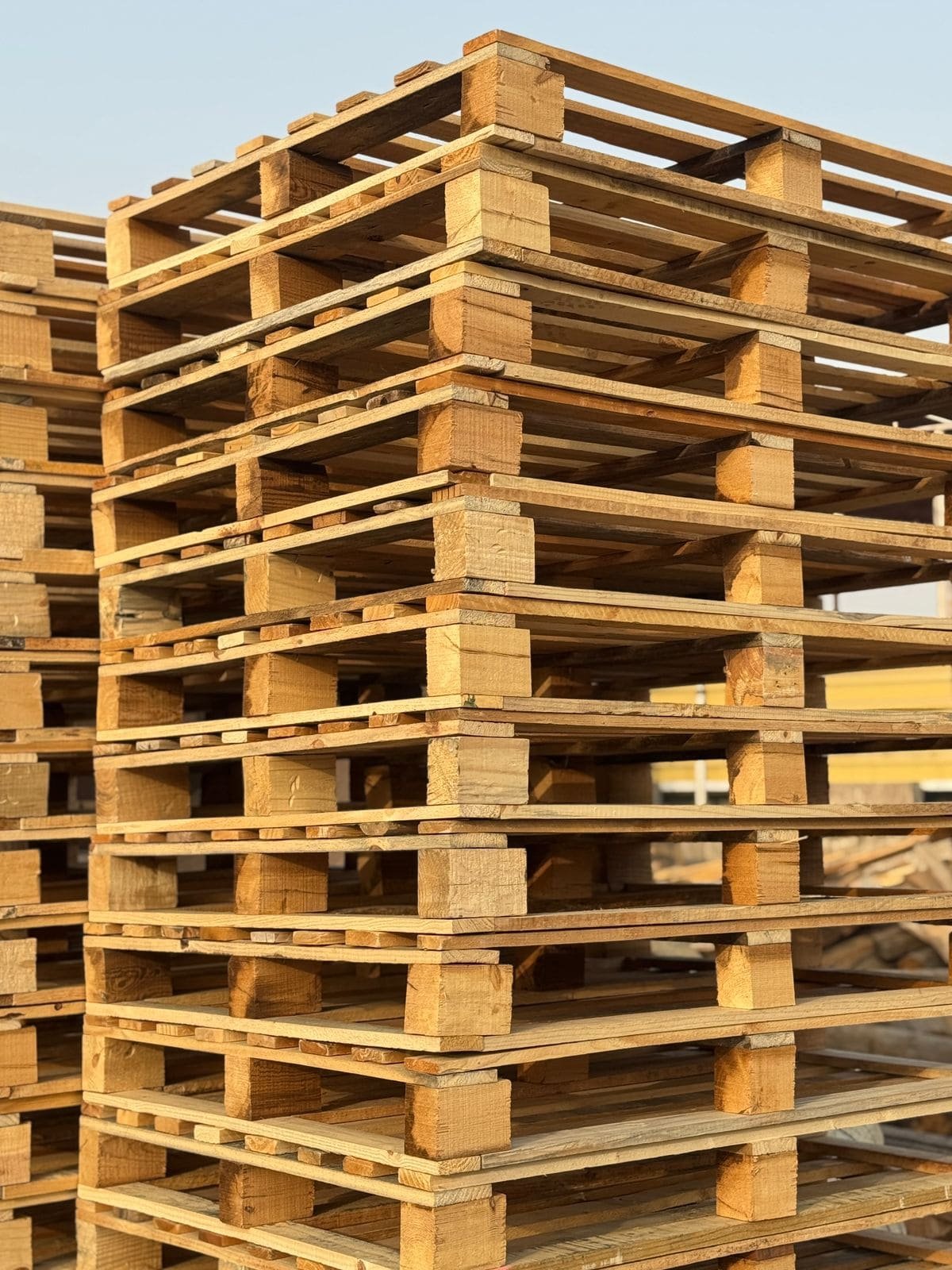
Al Rudhwan Carpentry operates one of the most sophisticated pallet sorting, repair, and reconditioning programs in the Northern Emirates. Understanding the operational differences enables procurement teams to deploy the optimal solution:
- When to Procure New ISPM 15 Pallets: Brand-new pallets are mandatory for primary pharmaceutical packaging, food and beverage processing, high-speed automated storage and retrieval systems (where board tolerances must remain within ±1mm), and prestigious export presentations where pristine aesthetic appearance is paramount.
- When to Procure Reconditioned Pallets: Reconditioned pallets represent an outstanding, cost-effective solution for secondary industrial packaging, one-way export consignments, construction material distribution, and heavy chemical handling. Reconditioned pallets deliver 35% to 45% cost savings compared to new units while delivering proven structural performance.
- Our Strict Reconditioning Audit Standard: Unlike casual scrap dealers who simply nail damaged boards back together, Al Rudhwan Carpentry subjects every returned pallet to rigorous grading. Any split, fractured, or compromised board or block is completely removed and replaced with virgin timber. Once fully refurbished, the entire pallet is loaded into our certified kiln facility for a fresh ISPM 15 thermal decontamination cycle and stamped with active verification markings.
11. Critical IPPC Stamping Deficiencies & Avoiding Port Rejections
International port biosecurity audits frequently reject wooden packaging due to preventable stamping errors. Understanding common compliance pitfalls protects UAE shippers from catastrophic freight delays:
- Missing Opposite-Side Marking: IPPC rules require stamps on at least two opposite vertical sides of the packaging. Pallets stamped on only one side are treated as non-compliant if that face is obscured inside a container.
- Illegible Ink Smearing: Using cheap water-based ink stamps that run or fade in coastal humidity results in immediate customs rejection. Al Rudhwan Carpentry uses high-temperature thermal heat branding that burns permanently into the wood fiber.
- Uncertified Component Substitution: If an uncertified board is used to repair a heat-treated pallet, the entire unit loses its certification. Every single component must originate from approved thermal cycles.
- Bark Retention Violations: Excess residual bark exceeding 3cm width on structural timber is an immediate red flag for foreign biosecurity officers, who suspect pest nesting under the bark layer.
12. Step-by-Step B2B Procurement Workflow: Custom Specifications, Load Testing & Dispatch
Procuring certified pallets from Al Rudhwan Carpentry is an efficient, transparent, and streamlined industrial process engineered to support rapid enterprise turnaround:
- Initial Technical Consultation: Contact our technical sales engineering desk via WhatsApp (+971 50 898 6636) or phone (+971 6 568 0024). Share your cargo details, gross payload requirements, container loading plans, and international destination country.
- CAD Dimensional Modeling & Specification Sign-Off: For custom pallets or industrial skids, our engineering team provides detailed dimensional 2D/3D technical drawings highlighting deck board spacing, block coordinates, nail patterns, and static/dynamic load calculations for formal client sign-off.
- Thermal Kiln Treatment & Quality Certification: Timber components undergo calibrated heat treatment inside our certified Sharjah kiln facilities. Each unit is permanently branded with the official IPPC registration mark, and digital thermal batch documentation is generated.
- Structural Load Testing & Batch Quality Inspection: Prior to loading, finished pallets undergo random batch deflection tests, moisture meter audits, and visual weld/nail inspections to guarantee zero structural defects.
- Direct Fleet Logistics & Delivery: Al Rudhwan Carpentry maintains an internal fleet of heavy transport flatbed trailers and closed curtain-siders providing prompt direct factory delivery to warehouses, factories, and port terminals across Dubai, JAFZA, Sharjah, Abu Dhabi, KIZAD, and all Emirates.
13. Sector Applications: Petrochemical, Heavy Machinery, FMCG & Cold Chain Solutions
Every major industrial vertical in the UAE presents unique operational packaging challenges. Our specialized engineering division tailors certified pallet configurations to meet the exact environmental demands of diverse economic sectors:
A. Petrochemical & Polymer Resin Exporters
Petrochemical refiners and plastics compounders in Ruwais, JAFZA, and Sharjah require standardized CP1, CP3, and CP7 chemical pallets designed to transport 25kg polymer bags and 200-liter chemical drums. Our chemical pallets feature perimeter base chamfers for smooth pallet truck entry, tight deck spacing to prevent bag puncture, and full heat treatment certification ensuring rapid customs clearance at Asian and European chemical discharge ports.
B. Oilfield & Heavy Rotating Machinery
Upstream oil and gas service companies, valve manufacturers, and turbine rebuilders demand extreme payload support. Al Rudhwan Carpentry engineers custom multi-ton solid hardwood skids utilizing 150x150mm European timber beams bolted with high-tensile steel threaded rods, dynamic load-rated up to 25 metric tons for offshore drilling rigs and refinery installations.
C. Cold Chain Logistics & Pharmaceutical Transit
Refrigerated warehouse facilities and pharmaceutical exporters operating in Dubai Industrial City and Dubai South require pallets with zero fungal spore contamination and pristine dimensional hygiene. By kiln drying our timber to under 14% moisture content, our cold-chain pallets prevent condensation formation inside sub-zero reefer containers (-20°C to +4°C), preserving packaging integrity and regulatory health compliance.
14. Technical Frequently Asked Questions (FAQ) Regarding ISPM 15 in the UAE
Q1: Is heat treatment (HT) mandatory for all wooden packaging leaving the UAE?
Yes. Virtually every major trading partner of the United Arab Emirates—including the European Union, the United States, Canada, China, Japan, Australia, India, and GCC nations—strictly enforces ISPM 15 regulations for all raw solid timber packaging exceeding 6mm in thickness. Failure to display valid, authentic IPPC heat treatment stamps will result in cargo rejection, mandatory port fumigation, or re-exportation at the shipper’s expense.
Q2: What is the exact difference between Heat Treatment (HT) and Chemical Fumigation (MB)?
Heat Treatment (HT) utilizes clean, pure thermal energy inside calibrated kilns to raise the core temperature of the wood to at least 56°C for 30 minutes, leaving zero toxic chemical residues. Methyl Bromide (MB) is a hazardous chemical gas that has been banned or severely restricted globally due to ozone layer depletion. Al Rudhwan Carpentry utilizes 100% clean Heat Treatment, fully compliant with global environmental and food/pharma safety standards.
Q3: How long does an ISPM 15 certification stamp remain valid on a wooden pallet?
An ISPM 15 heat treatment mark has no theoretical expiration date. The certification remains legally valid for the entire lifespan of the pallet, provided that no structural alterations, board replacements, or repairs are performed using untreated timber, and the wood remains free of biological re-infestation or severe contamination.
Q4: Are plywood, OSB, and particleboard pallets required to undergo ISPM 15 heat treatment?
No. Processed engineered wood products such as plywood, oriented strand board (OSB), hardboard, and compressed particleboard are created utilizing high industrial heat, chemical resins, and extreme pressure during manufacturing. Under IPPC guidelines, processed wood is officially exempt from ISPM 15 treatment. However, if a plywood pallet utilizes solid timber base runners or solid wood corner blocks, those solid components must be heat treated and stamped.
Q5: Can Al Rudhwan Carpentry treat our company’s existing customer-supplied pallets?
Yes. We offer commercial toll heat treatment services for client-owned pallets, wooden crates, and structural timber. You can deliver your packaging material to our Sharjah Industrial Area 13 facility, where it will undergo our full certified kiln thermal treatment cycle, receive official IPPC stamps, and be issued official compliance certification.
Q6: What is the typical lead time for custom-sized certified wooden pallets in the UAE?
For standard Euro (1200×800) and ISO (1200×1000) pallets, Al Rudhwan Carpentry maintains finished stock ready for same-day or next-day dispatch across Dubai and Sharjah. For custom-engineered industrial pallets and heavy-duty machinery skids, typical production turnaround is 24 to 48 hours depending on order volume and engineering specifications.
Q7: How do I verify that an IPPC stamp is genuine and not counterfeit?
A genuine IPPC mark must be heat-branded or permanently stenciled within a clear border, featuring the wheat ear logo, ISO country code (AE), a registered manufacturer code, and the treatment indicator (HT). Furthermore, the supplier must provide an authentic, timestamped Heat Treatment Certificate matching the facility code displayed on the wood.
Q8: Does Al Rudhwan Carpentry deliver to JAFZA, Abu Dhabi, and KIZAD?
Yes. Our dedicated transport fleet provides daily direct deliveries to JAFZA North/South, Dubai Industrial City, Dubai South, Sharjah Industrial Areas, Abu Dhabi Mussafah, and KIZAD. Full trailer-load deliveries can be scheduled around the clock to meet vessel loading cutoff times.
15. Conclusion, Quality Checklists & Placing Your Factory Direct Order
Securing your international supply chain against port rejections, customs fines, and structural transit failures requires an uncompromised commitment to packaging quality. By partnering directly with Al Rudhwan Carpentry—an established, fully certified UAE manufacturer operating authorized kiln treatment facilities—your organization gains total compliance certainty, direct factory-gate pricing, and rapid delivery response across the Emirates.
Ready to Secure Your Export Consignments? Get an Immediate Factory Quote
Contact our industrial engineering and compliance team directly. Whether you require a single truckload of standard Euro pallets or hundreds of custom heavy-duty export skids, we deliver guaranteed ISPM 15 compliance at direct mill rates.